Why Reading basements flood
Reading sits beside the Schuylkill River. The river crested at 31.3 feet in June 1972, more than double its 15.5-foot flood stage, and heavy rain still sends water toward low ground. Many blocks are built on slopes, and many basements sit below street level.
Older foundations may lack interior drains. Water that cannot get out finds the weakest point, often a floor crack, a wall joint or a drain.
First, find out what kind of water it is
| Water looks or smells like | Likely source | What to do |
|---|---|---|
| Clear, no smell, from a wall or the floor | Groundwater or rain seepage | Check the sump pump and see sump pump service |
| Clear, spraying or dripping from a pipe | A supply leak or burst | Close the main and see burst pipe repair |
| Gray or dark, from the floor drain | Backed-up drain or sewer | Stop using water and see sewer line repair |
| Water from the water heater | A failed tank | Shut off the supply and call the plumber |
Sewage or flood water is not clean water. Do not wade in it and do not touch affected items with bare hands.
The first hour
Stay safe
Standing water close to outlets, the panel or appliances means stay out. Cut power only if the breaker is dry and reachable.
Stop the source
Close the main if a pipe is leaking. Stop running water if a drain is backing up.
Check the pump
Make sure the sump pump is plugged in and the float moves. Only if the floor around the pit is dry and nothing electrical is in the water, lift the float by hand to see if it runs.
Document
Photograph the water, the source and the damage before moving anything.
Call
Say whether you have a sump pump, whether the water is clean and how deep it is.
Drying and mold
The EPA advises that water-damaged areas and items be dried within 24 to 48 hours. In most cases mold will not grow if materials are dried in that window. That is a short time, which is why removing water quickly matters.
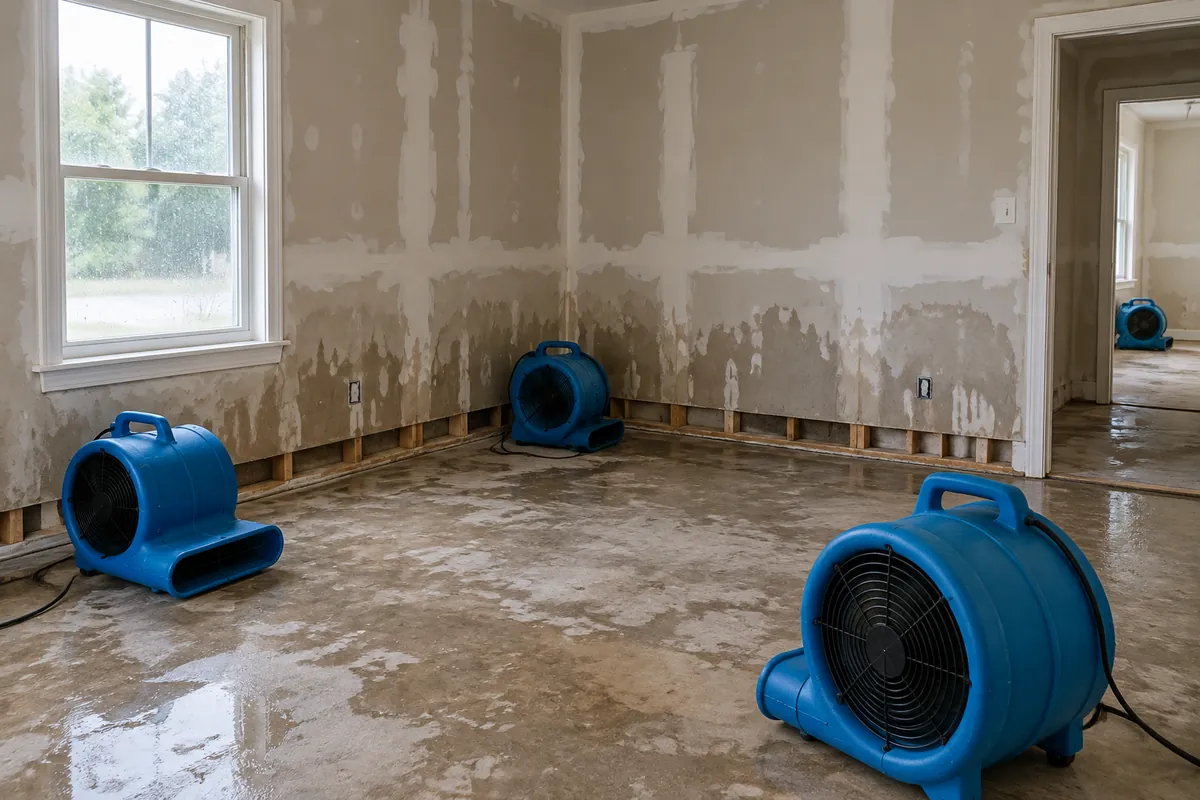
If water has soaked drywall, carpet or insulation, professional drying may be needed. See water damage restoration for how extraction and drying work.
Insurance and basement flooding
Homeowners policies treat different kinds of water differently. MoneyGeek notes that a standard policy covers water that suddenly escapes a broken or frozen pipe inside the house, but not water that comes back through drains, sewers or a sump pit. That needs a separate water backup endorsement.
Flood damage from rising water outside the house is also typically a separate coverage. Read your policy now, before the next storm.
Cleaning up after clean water versus dirty water
Clean water from a supply line can often be removed with a wet vacuum and fans, if the area is small and dries quickly. Carpet and padding that stay wet beyond a day or two are likely to grow mold and may need replacing.
Water from a drain or from outside is different. It carries bacteria and should be handled with gloves and boots, and porous materials that touched it are usually discarded. Professionals follow the IICRC S500 standard, which sorts water into categories by contamination.
| Material | After clean water | After sewage or flood water |
|---|---|---|
| Carpet and pad | Dry fast, or replace the pad | Usually discard |
| Drywall | Cut out what is saturated | Cut out and discard |
| Concrete floor | Dry and clean | Clean and disinfect |
| Stored cardboard | Often discarded if wet for long | Discard |
Electrical safety in a wet basement
Water and electricity make basement flooding dangerous. The panel, outlets, a furnace, a water heater and a washing machine can all be near the floor. Do not step into standing water if any of these might be energized.
If water is near the panel or outlets, do not go near it. Call the electric utility or a plumber for help, and turn off breakers only from a fully dry spot. Do not run extension cords through standing water to power a pump.
Sump pump checks that take five minutes
Pour a five-gallon bucket of water into the pit. The float should rise, the pump should start, the pit should empty and the pump should shut off. If it does not, the pump or float needs attention before the next rain.
Look at the discharge pipe outside. It needs to send water far from the foundation, not release it beside the wall. A pipe that is frozen, crushed or clogged is a frequent reason a pump that runs fine still leaves the basement wet.
Why basements flood again after the first time
A basement that floods once has a reason. The reason may be a pump that is too small, a floor drain with no backwater valve, a cracked wall or a gutter that dumps water against the foundation. Drying the basement without addressing the reason leaves it ready to flood again.
Ask a plumber to walk through the sources. Water from a drain, a pipe and the ground each have a different fix, and a basement can have more than one at once.
Preventing the next flood
- Test the sump pump before wet seasons by pouring water into the pit.
- Consider a battery or water-powered backup for outages.
- Make sure the discharge pipe carries water well away from the house.
- Keep floor drains clear and consider a camera look at the main line.
- Move stored items off the floor and onto shelves.
A house that floods once usually floods again unless the cause is fixed. A plumber can tell you whether the fix is a pump, a drain, a pipe or a combination.