Why drains in older Reading homes clog again and again
The first clog in a pipe is usually behavior: grease, hair, wipes or a dropped toy. A clog that returns every few months is usually the pipe itself. Many older homes have clay or cast iron drains, and both materials age in ways that trap debris.
Cast iron scales on the inside, so the opening shrinks year by year. Clay comes in short lengths, and each joint is a spot where roots can enter or the line can drift out of alignment. Roots go looking for the moisture seeping at a joint and thicken until they catch paper and grease.
That is why a cable that clears the line today may only buy a few months. If the same drain has needed clearing twice in a year, ask for a camera inspection. It shows whether the pipe is dirty, rooted, cracked or offset, and each of those has a different fix.
Which fixtures are slow tells you how serious it is
Count the affected fixtures first. One slow sink points to its own branch line. Several fixtures slowing or gurgling together point to the main line. Water that rises in the lowest opening in the house, often a basement floor drain, means the main line is backing up.
| What you notice | Where the blockage probably sits | How soon to act |
|---|---|---|
| One sink or tub is sluggish | The trap or branch under that fixture | Often fine until a daytime visit if you stop using it |
| Only the toilet refuses to flush | The toilet's own trap or short branch | Moderate. Stop flushing |
| Tub gurgles when the washer runs | The main line or a shared branch | High. Stop running water |
| Floor drain in the basement fills | The main line or the lateral to the street | Emergency. Phone now |
| Sewer odor indoors or damp ground near the cleanout | The main line or lateral | Emergency. Phone now |
Cable, jet or camera: matching the tool to the clog
The right method depends on what fills the pipe. A good plumber explains the choice, because the wrong tool opens a hole through the clog and leaves the cause behind.
| Method | Suits | Where it falls short |
|---|---|---|
| Hand cable or small drain snake | Hair, soap and soft buildup in sinks and tubs | Bores a hole through the clog and can leave grease on the wall |
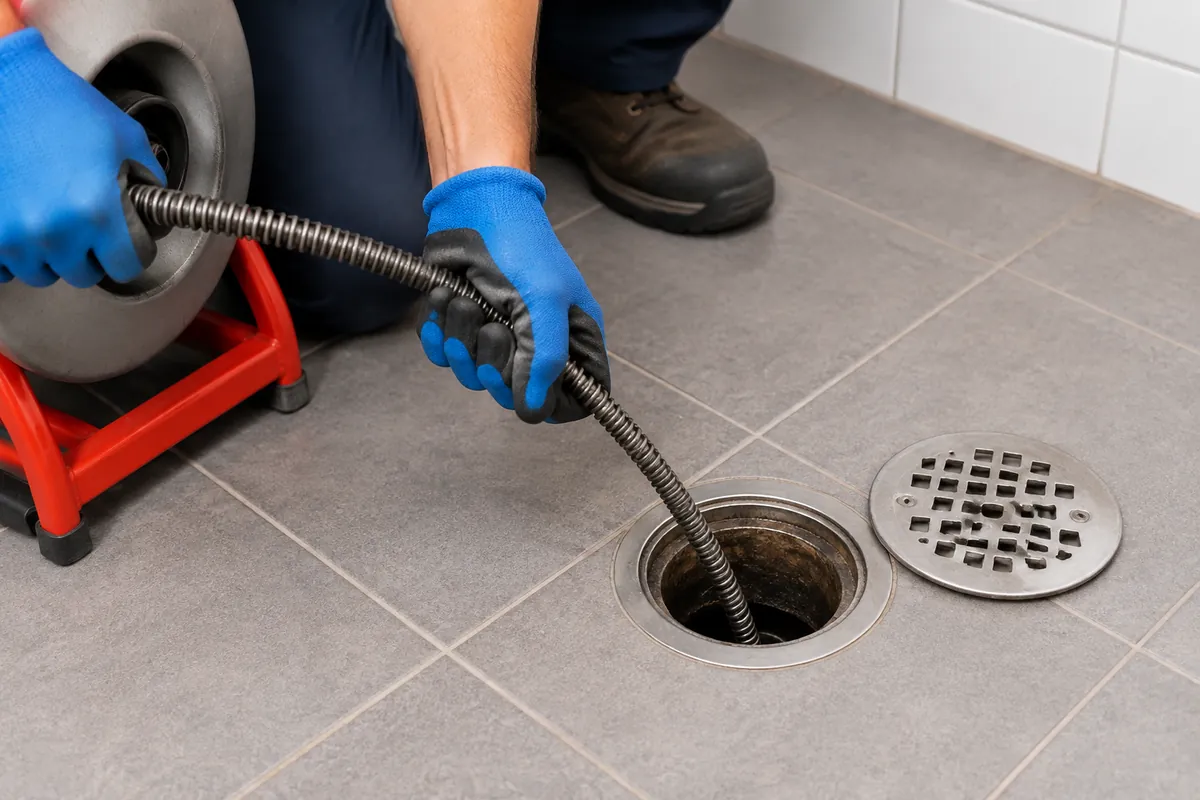
| Drum or sectional cable machine | Main lines, roots and heavy blockages | Opens a channel without scouring the full pipe wall |
| Hydro jetting | Grease, scale and fine roots that keep returning | Not for cracked or collapsed pipe |
| Camera inspection | Finding the cause and checking pipe condition | Shows the problem but does not clear it |
On a main line the camera often goes in first. It answers the real question, which is whether the pipe is simply coated or actually damaged. A collapsed section needs sewer line repair, and more cleaning will not help it.
Steps to take while you wait
- Stop all water use. Each gallon from the laundry, dishwasher or shower has no place to go.
- Leave chemical drain cleaner on the shelf. It harms pipe and burns whoever opens the line next.
- Find the cleanout, a capped pipe by the foundation, in the basement or near the property line. It is the quickest way into the main line.
- Keep kids and pets off any wet floor. Sewage carries bacteria.
- Take photos of any overflow before you begin cleanup, for your insurer.
Who owns the pipe
The lateral runs from the house to the municipal sewer main. In many municipalities the owner is responsible for it, and the rules differ by borough and for the City of Reading. The local public works office can tell you where your part ends.
A camera pass shows which side of the connection holds the blockage. That avoids calling the wrong party and avoids paying to excavate a pipe someone else maintains.
When a backup turns into a water damage job
Once sewage soaks carpet or drywall, it stops being a mopping job. The IICRC S500 standard, used throughout professional restoration work, treats backup water as contaminated, and porous materials it touched usually cannot be saved.
If flooring or drywall is soaked, see water damage restoration in Reading. The line has to be cleared first, since drying cannot begin while more water keeps arriving. Standard homeowners policies often exclude water that comes back up a drain, so ask your insurer about a backup endorsement.
What moves the price of drain cleaning
- Where the clog is. A single fixture is cheaper than a main line, which needs bigger machines and longer time.
- Method. A cable pass is priced below hydro jetting, and a camera visit is billed on its own.
- Access. A cleanout near the clog speeds things up. Without one, the plumber may have to go in through a toilet or a roof vent.
- Hour of the call. Nights and holidays can be priced differently from daytime.
Ask the plumber to explain the likely method and cost before starting, so you can decide with the numbers in front of you.
Habits that keep pipes open
Let cooking grease cool in a can and bin it, instead of rinsing it away. Put a hair catcher in the shower drain. Wipes, paper towels and cotton swabs go in the bin, whatever the packaging claims about flushing.
A drain that slows every few months suggests scale or roots, and one camera look is cheaper than several emergency calls. A stain under a bathroom floor can mean a leaking drain line instead of a slow one, which is a job for leak detection. The same advice holds in Shillington, Sinking Spring and the other boroughs near Reading.