Signs the problem is the sewer line
One slow drain points to a local clog. Several fixtures acting up together point to the main line. Watch for the pattern.
- Gurgling in a tub or toilet when the washing machine drains.
- Water or sewage coming up in a basement floor drain.
- More than one fixture backing up at once.
- A sewer smell in the yard or the basement.
- Soggy ground or a sunken patch along the line to the street.
A single clog is a drain cleaning job. If the same line clogs again within weeks, it likely needs a camera. A cable only clears the blockage, and the cause may still be there.
What a camera inspection shows
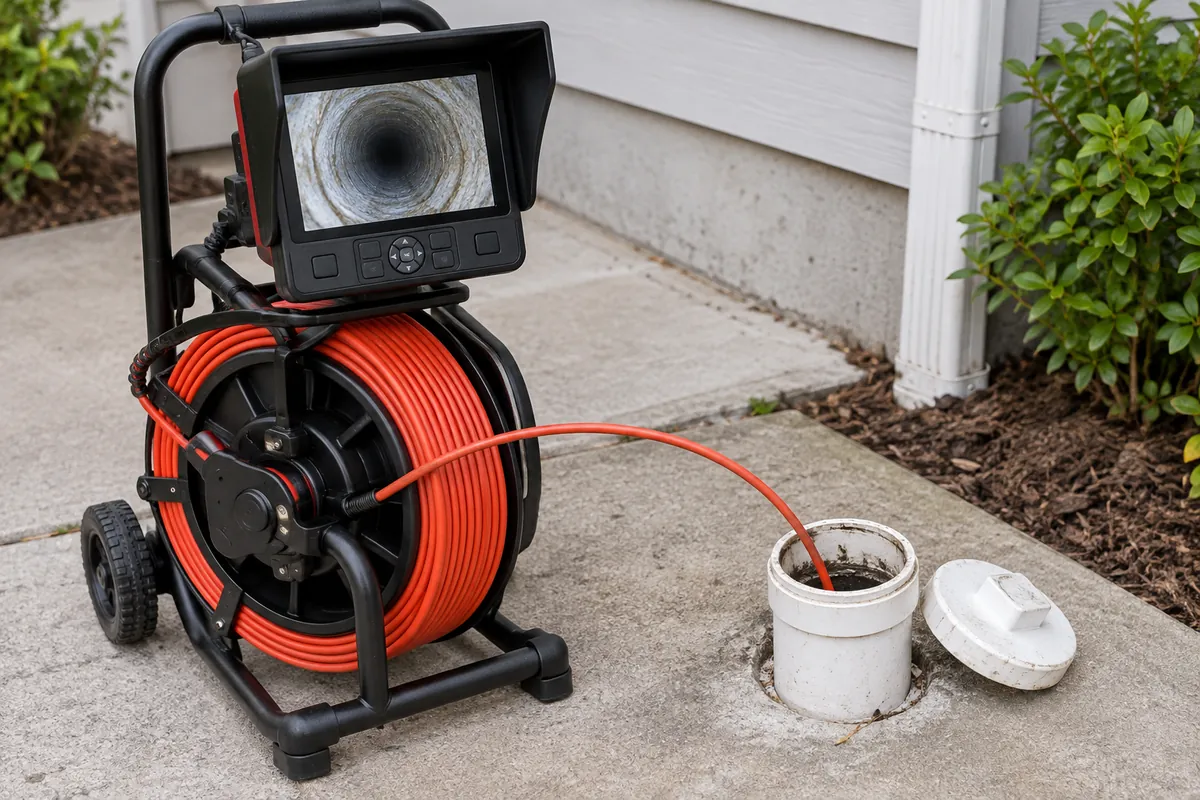
A small camera on a flexible cable runs through the line and shows its condition in real time. It is the most direct way to see why a line fails without digging.
The plumber can see roots, cracked or offset joints, collapsed sections, sagging pipe that holds water and buildup. The depth and distance of the problem can be located from above, so a repair can be planned for one spot.
| What the camera finds | What it usually means | Typical response |
|---|---|---|
| Roots entering at joints | Joints have opened, often in clay or old cast iron | Clear the roots, then repair or line the joint |
| A crack or offset joint | Ground movement or age | Spot repair of that section |
| A belly, or sag | The pipe has settled and holds water | Replace the sagging section |
| A collapsed section | The pipe has failed completely | Dig and replace that section |
| Heavy scale or grease | Buildup, not a break | Hydro jetting and monitoring |
Spot repair, lining or replacement
Which repair fits depends on how much of the line is bad. A single failed joint is a spot repair. Long runs of damage point toward lining or full replacement.
A plumber will describe the choice based on the camera footage. If most of the line is failing, see sewer line replacement.
Older homes and older pipe
Many older neighborhoods were built when clay tile and cast iron were the standard drain materials. Clay lines have many joints, and each is a place for roots to enter. Cast iron rusts and scales from the inside.
A house built before the middle of the last century is more likely to have one of these. It does not mean the line is bad. It means a camera inspection is worth doing before assuming.
Who is responsible
The house side of the line is generally the owner's responsibility, up to the connection to the municipal sewer. Where that connection is, and who owns the lateral between the property line and the main, can vary by municipality, so ask the borough or the city sewer authority about your address.
Warning signs before a backup
Lines usually complain before they fail. Toilets that bubble when the shower drains, a faint sewer smell in the basement and the same cleanout needing attention every few months all point to a line in decline.
A camera visit at that stage costs less than an emergency one. It turns a surprise into a plan, and it shows whether the problem is a clog that returns or a pipe that has changed shape.
- Know where the cleanout is, usually a capped pipe in the basement or yard.
- Keep wipes, grease and paper towels out of the drains.
- Do not plant trees near the line to the street.
- Get a camera look when a house is bought, especially an older one.