A drip is more than a noise
A dripping faucet looks small, but it adds up. The EPA says household leaks waste more than 9,300 gallons a year on average, and toilets and faucets are common sources. A steady drip also stains the basin, and a leak under the sink soaks the cabinet floor where nobody looks until the wood swells.
The cause is nearly always a worn internal part. Faucets are built around a small valve that opens and closes thousands of times a year, and seals inside it wear out. The fix is usually a part, not the whole faucet.
What fails inside each kind of faucet
The right repair depends on the valve type. A plumber can usually tell the kind by how the handle moves and when it was installed.
| Faucet type | How it feels | What usually fails |
|---|---|---|
| Compression (separate hot and cold handles) | Handle tightens down to stop the flow | Rubber washer and seat. Common in older homes |
| Cartridge | Single handle or two, smooth motion | Worn cartridge and its O-rings |
| Ball | Single handle over a ball-shaped cap | Springs, seats and the ball itself |
| Ceramic disc | Single lever, smooth, quiet | Seals under the discs, or mineral buildup |
Older faucets from earlier decades often have compression valves, so a drip is a washer and seat replacement. Newer single-handle faucets leak from a cartridge or from worn O-rings around the base. Matching the exact replacement part is the main reason a faucet repair can take longer than expected.
Leaks under the sink
Water under the sink does not always come from the faucet. Run the faucet for a minute with a dry paper towel held against each fitting, working from the top down. The wet fitting is the culprit.
The common sources are the flexible supply lines that connect the stops to the faucet, the angle stops that shut off water to the faucet and the P-trap that holds water below the drain. Braided supply lines last years but can fail suddenly at the end fittings. Angle stops that have not been turned in years seize or drip at the stem once you try them.
In older Reading homes, copper or brass fittings are often joined to galvanized steel supply stubs. The two metals corrode where they meet, which seals a joint tight for years and then lets it weep. A plumber can separate them with a dielectric fitting.
Repair or replace the faucet
- Repair when the faucet is sound and a seal, washer or cartridge is worn.
- Replace when the body is pitted, the finish has failed, parts are no longer made or the faucet has leaked more than once.
- Replace when you want a different flow. The EPA's WaterSense label for bathroom faucets means a maximum flow of 1.5 gallons per minute, compared with 2.2 gallons per minute for a standard one.
- Replace the supply lines and stops at the same time. The faucet is rarely the oldest part under the sink.
A good plumber tells you which of those fits before any parts are ordered. See leak detection if you suspect the water you see is coming from somewhere other than the faucet.
When it counts as an emergency
Treat a faucet or sink leak as an emergency when water is spreading across the floor, when a supply line is spraying, when the angle stop will not close or when water is running down into a ceiling or basement below. Close the stops or the main shutoff first.
A slow drip can wait for a daytime visit. If the dripping is at the handle and you can feel the handle wobble, schedule the repair soon, since a loose body can fail suddenly.
Sink drains, traps and related fixtures
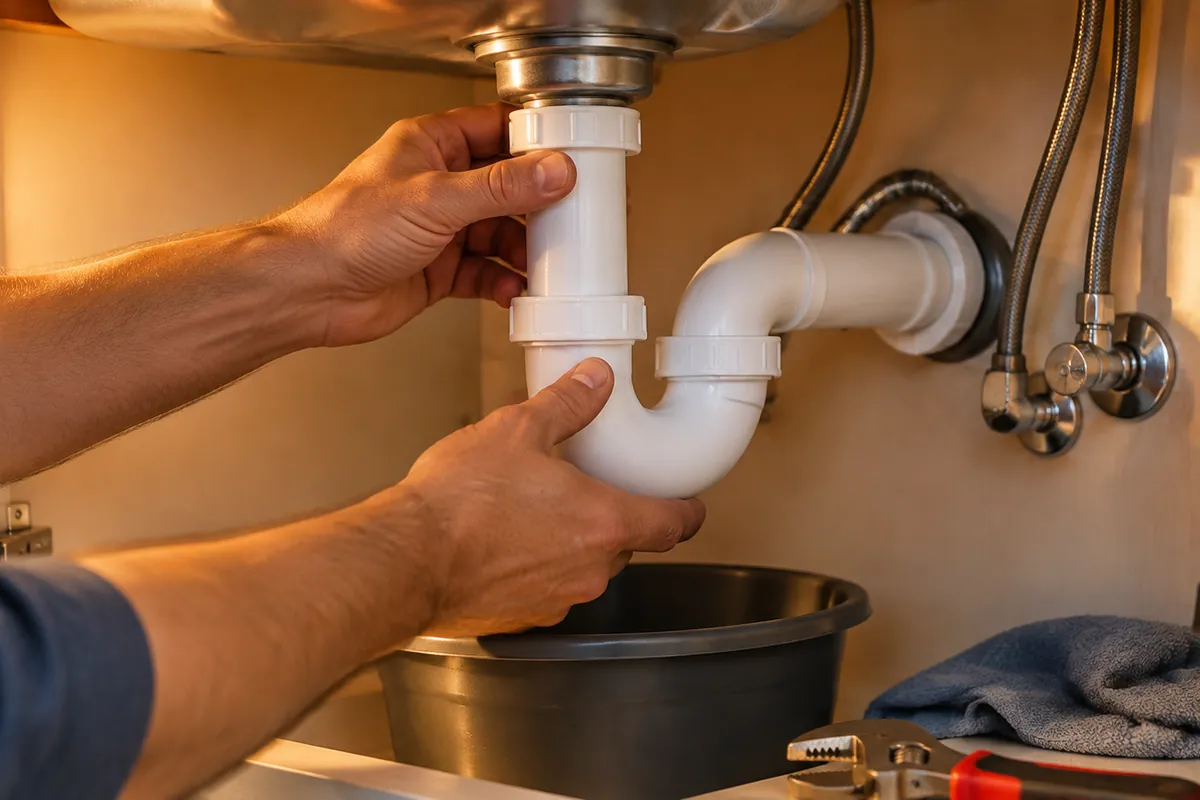
A leak at the drain below the basin is a trap or slip-joint problem, not a faucet problem. Slip nuts loosen, washers flatten and plastic traps crack. The fix is usually quick, but a leak that returns may mean the drain line behind it has a deeper issue.
If the sink drains slowly as well as leaks, the trouble can be a partly blocked line, which is a drain cleaning job. If a disposal sits below the sink, a leak from that unit is a garbage disposal repair question. Toilets and shower valves have their own pages for toilet repair and shower and bathtub installation.
What affects the cost
- The kind of faucet and whether the exact part is available.
- Whether the supply lines and angle stops also need replacing.
- The accessibility of the fittings, since a tight vanity makes the work slower.
- A new faucet's price if you choose to replace it.
- The time of day, since night and holiday visits may be priced differently.
The plumber explains the likely fix before starting work. Homeowners insurance rarely covers a worn faucet, though it may respond to sudden water damage in the cabinet or floor below. The same advice applies in West Reading and the nearby boroughs.