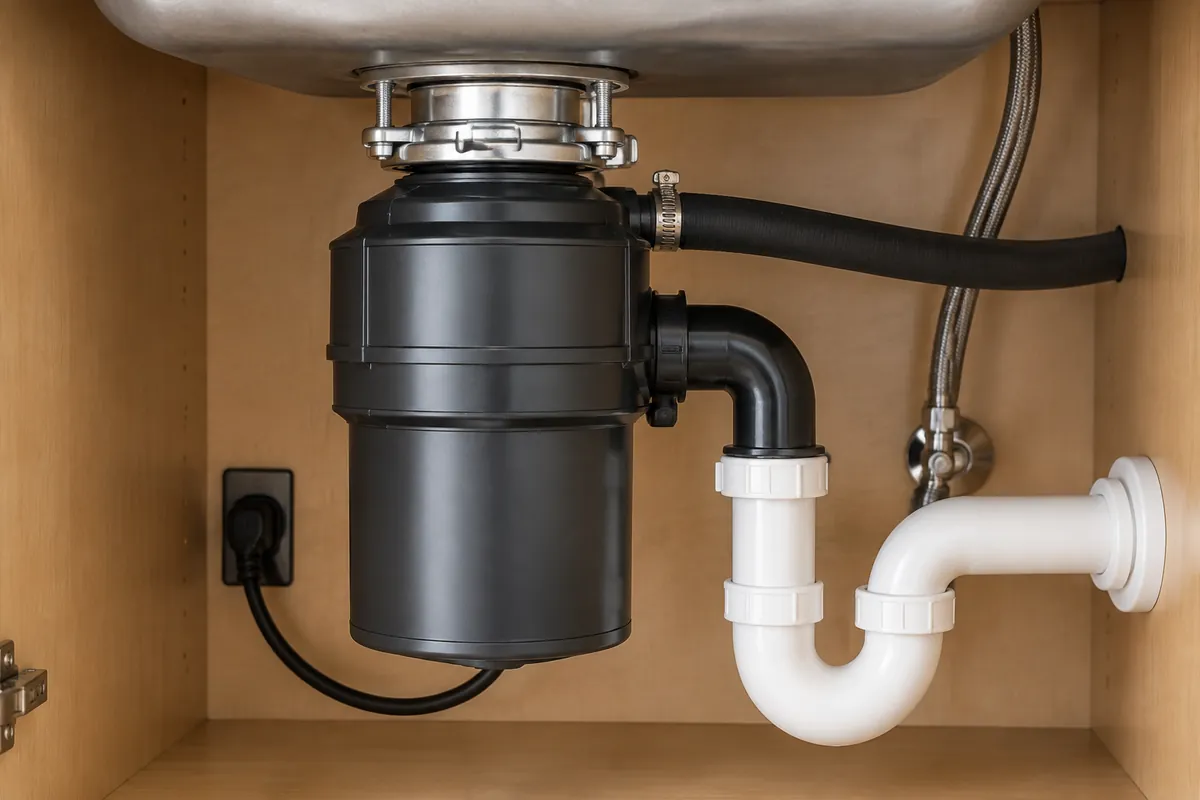
What the sound or the symptom tells you
A garbage disposal gives clear signals when it fails. The sound it makes, or the lack of one, points to a cause in under a minute, and that tells you whether a reset will do or a plumber is needed.
| What you notice | Most likely cause | Safe first step |
|---|---|---|
| Humming, but the blades do not turn | Something is wedged against the grinding plate, or the motor is seized | Power off, then turn the hex socket on the underside back and forth |
| Completely silent, no hum | Tripped reset button, tripped breaker or GFCI, or a dead motor | Press the red reset button on the bottom, then check the breaker |
| Grinding with a metallic rattle | A spoon, bottle cap or other hard object in the chamber | Power off, then remove it with tongs and a flashlight, never fingers |
| Water leaking from the top or flange | Failed mounting gasket or dried plumber's putty | Dry the area, run water, and note exactly where it drips |
| Water leaking from the side or a hose | Loose dishwasher hose or drain elbow connection | Check the clamps for looseness |
| Water leaking from the bottom of the unit | Internal seal failure in the housing | Plan on replacement, since the housing cannot be resealed |
| Sink backs up into the second basin | A clog downstream of the disposal in the kitchen drain | Stop running water and read the drain section below |
Freeing a jam without making it worse
Nearly every disposal has a hex-shaped socket in the center of its underside. A quarter-inch hex key fits most models, and many came with one taped to the unit. Working the key back and forth by hand rotates the grinding plate and frees most jams.
Once the plate turns freely, press the red reset button on the underside, restore power and run cold water while the unit runs for ten seconds. If it hums again right away, the motor may be failing or the object is still lodged, and repeated resets only overheat the windings.
Skip chemical drain cleaner. It sits in a blocked line, damages seals and puts caustic liquid in front of whoever opens the trap next. Cold water from the tap and a short run of the unit is the right test.
Repair or replace: how a plumber decides
Repair makes sense for a stuck plate, a loose connection, a failed gasket or a reset problem. Those jobs are quick and cheap relative to the unit. Replacement makes sense when the body leaks, the motor is seized or the unit is old enough that the next failure is close behind.
Many disposals last roughly a decade, depending on use. A unit that is leaking from the housing cannot be fixed, because the seal sits inside the casing. The plumber will usually tell you on the call whether the symptoms you describe sound like a repair or a swap, and the estimate follows from that.
- A leak from the bottom or the body means the housing has failed. Replace the unit.
- A leak at the top flange is often a new gasket or fresh plumber's putty.
- A jam that clears and does not return was probably a one-time object.
- A unit that jams or trips the reset every week is wearing out.
- Corroded mounting rings and cracked sink flanges are signs the install itself needs attention.
Installing a new disposal
A replacement follows the same mounting pattern as the old unit on many sinks, which keeps the job short. A first-time install needs more: a power source with a switch, a drain connection that fits the unit's outlet, and clearance in the cabinet for the larger drain assembly.
Dishwasher connections catch people out. New units have a knockout plug in the dishwasher inlet, and it has to be removed when the dishwasher is connected. If it stays in, the dishwasher cannot drain, and water pools in the bottom of the machine after a cycle. The plumber checks for this before leaving.
In many homes the sink drain beyond the disposal is old. Older kitchen lines can be steel or cast iron, and they narrow with grease over the years. A new disposal does not fix a narrowed line, and it can make a marginal line clog sooner.
When the drain, not the disposal, is the problem
If the disposal runs normally but water rises in the sink or comes up in the other basin, the clog is downstream. A disposal grinds food into small pieces, and grease in the waste still cools and coats the pipe wall. Over months the pipe narrows until one heavy meal closes it.
That is a drain cleaning job, not a disposal repair. A cable or a pressure-jetting pass clears the kitchen branch, and a camera shows whether the line is merely greasy or damaged. In older Reading homes the kitchen waste often runs through cast iron, which scales inside, so repeated clogs deserve an inspection.
A disposal that leaks only when a faucet runs is sometimes a faucet or supply problem, not the unit. A quick look under the sink with a dry paper towel shows where the water starts. If the source is the faucet, faucet repair is the right call.
What affects the cost
- The fix itself. A jam or reset costs far less than a new unit, and a new unit costs less than one that also needs a new sink flange or drain parts.
- Horsepower and build. Larger motors and stainless grinding parts cost more and handle heavier use.
- Wiring. A sink with no outlet or switch under the cabinet needs electrical work, which may need a separate tradesperson.
- Condition of the drain. Corroded or narrowed pipe beyond the unit adds time and materials.
- Timing. A night or weekend visit may be priced differently from a daytime appointment.
Homeowners insurance rarely pays for a worn-out disposal, though it may respond to sudden water damage from a failed unit. Check your policy wording. Prices depend on the unit, the sink and the plumber. Call and describe the problem.
Keeping a disposal working
Run cold water for several seconds before, during and after use. Feed food in gradually. Fibrous scraps such as celery strings and corn husks wrap around the blades, and starchy foods such as rice and pasta swell into paste. Grease, oil and coffee grounds in volume belong in the trash.
The same advice holds in Wyomissing, West Reading and across the Reading area. A unit that is used gently lasts longer, and the line behind it stays open.