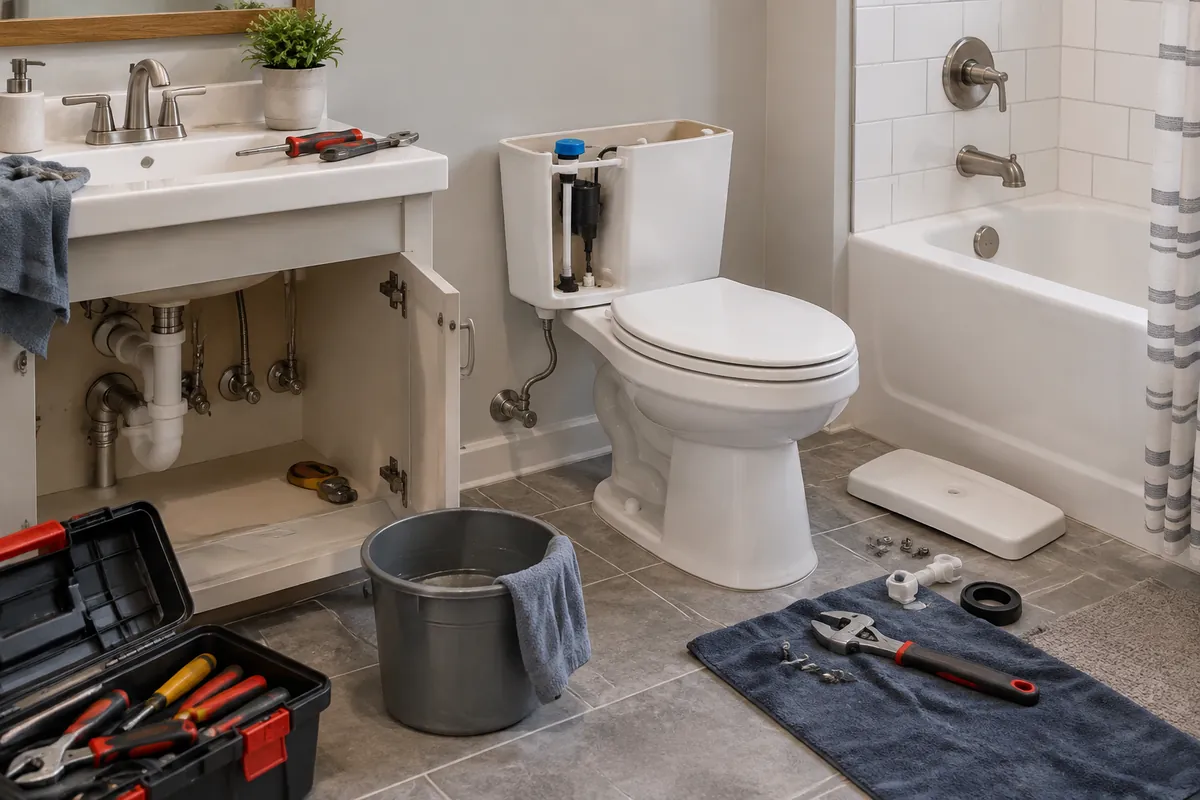
The five usual toilet problems
| Problem | Usual cause | Quick check |
|---|---|---|
| Keeps running | Worn flapper, or a fill valve that will not shut | Look for water trickling into the bowl |
| Weak flush | Clogged rim jets or a low water level in the tank | Check the water line in the tank |
| Clogs often | A partial blockage in the trap or the drain beyond it | Plunge once, then see if it returns |
| Leaks at the base | A failed wax ring or loose closet bolts | Dry the floor and watch for water at the base |
| Rocks on the floor | Loose bolts or an uneven floor | Press on the bowl and check for movement |
A running toilet is the most common one. It is also the most wasteful. The EPA lists leaking toilets among the most common household leaks.
An overflow that will not stop
Stop the flow
Take off the tank lid and push the flapper into its seat, or lift the float.
Close the supply
Turn the valve behind the toilet fully clockwise.
Do not keep flushing
More flushes only add water to a full bowl.
Check the other drains
If a shower or sink is also slow, the clog is further down. See drain cleaning.
When the wax ring is the problem
A toilet sits on a wax ring that seals it to the drain. When the seal fails, water leaks at the base and often goes unnoticed because it is under the bowl. Soft flooring, a sour smell or a stain on the ceiling below are common clues.
Replacing the ring means lifting the toilet. If the subfloor is soft, that may be a bigger repair. The plumber can check it while the toilet is up.
A water-saving replacement
Older toilets can use several gallons per flush. EPA WaterSense models use 1.28 gallons or less. If your toilet is old and needs frequent repairs, a replacement can pay back in water savings.
A plumber can set the new toilet, check the shutoff valve and make sure the flange is in good shape. Old angle stops can fail or leak when turned, so they are sometimes replaced at the same time.
Fixes you can try, and where to stop
Replacing a flapper or adjusting a float are reasonable first repairs, and most hardware stores stock parts. Plunging a clogged bowl with a flange plunger is safe too.
Stop when a repair needs the toilet lifted, when water appears at the base or when the drain is slow in other fixtures. At that point the problem is a wax ring, a flange or the drain line, and a plumber should look.