Start with safety
If you smell gas near the heater, leave the building and call 911 or the gas utility from outside. Do not try to relight the pilot. If water is pooling at the base of the tank, close the cold supply valve above it and turn off the power or gas.
A leaking tank cannot be repaired, and a heater that is both leaking and hot is a hazard. Everything else on this page assumes there is no gas smell and no active leak.
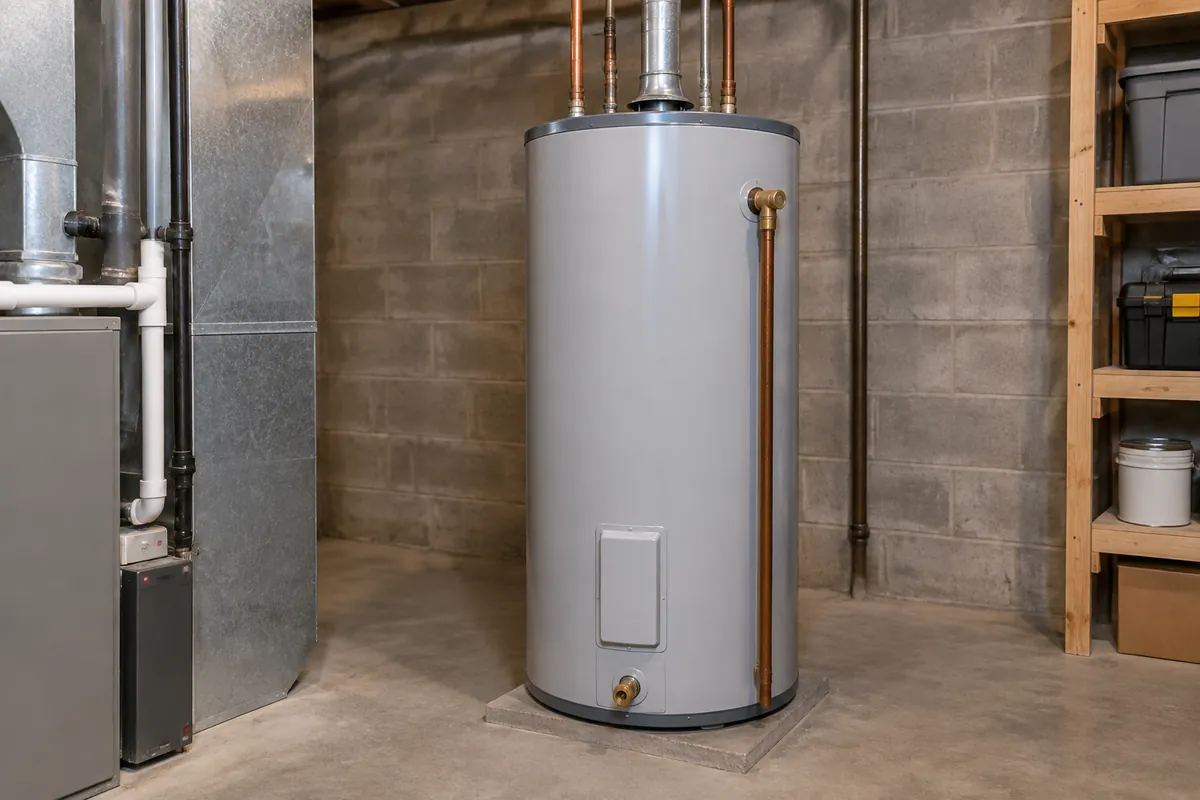
First, work out which kind you have
| Type | How to tell | What heats the water |
|---|---|---|
| Gas tank | A vent pipe on top and a gas line at the bottom | A burner, lit by a pilot or an electronic igniter |
| Electric tank | No vent, with a heavy electric cable going in | Two heating elements inside the tank |
| Tankless | A wall-mounted box with no tank | A burner or element heats water as it flows |
Electric heater checks
Check the breaker
Water heaters use a double breaker. If it is tripped, reset it once. If it trips again, stop.
Press the reset button
Many electric heaters have a red button behind the upper panel. Turn the breaker off before you remove the panel. A tripped limit switch will not heat until it is reset.
Check the thermostat
Make sure it has not been turned down.
Know what repeats
If it trips again, an element or a thermostat has failed and needs a plumber.
Never open an access panel with the power on. Turn off the breaker first.
Gas heater checks
Look at the thermostat dial
Confirm it is set to a working temperature and not on vacation mode.
Check the pilot or the display
A lit pilot is a small blue flame. A control with a display may show a fault code.
Relight only if the label tells you how
Follow the instructions printed on the heater. If it will not stay lit, stop.
Check the gas supply
Make sure the gas valve at the heater is open and other gas appliances are working.
A pilot that keeps going out can mean a failing thermocouple, a draft or a dirty burner. That is a plumber's job, and it is a safety item, not a nuisance.
Clues in how the water behaves
| What you notice | What it often means |
|---|---|
| Lukewarm only | One failed element or a thermostat set too low |
| Hot at first, then cold | A broken dip tube or a small tank for the household |
| Hot at the tank, cold at a faucet | A faucet or mixing valve problem. See faucet repair |
| Rumbling or popping | Sediment on the bottom of the tank |
| Rusty water | Corrosion inside an aging tank |
When it is the whole heater
If the tank leaks, the unit is more than about ten years old or repairs are repeating, replacement is the better move. See water heater replacement and water heater repair for the decision.
If you are weighing a tankless unit, read the tankless page first. The gas and venting work is usually where the cost grows.
Why hot water goes quickly in cold months
In winter, the water entering the house is colder, so the heater has to raise it further. A household that had enough hot water in July can run short in January with the same tank. Showers feel shorter and the heater runs longer.
If the symptom shows up only in cold months and the heater is otherwise fine, the thermostat may need adjusting or the tank may be small for the household. A plumber can help you decide whether a larger tank, a recovery check or a tankless unit makes sense.
Sediment and age
Minerals settle at the bottom of a tank over time. A gas heater heats the bottom of the tank, so a layer of sediment insulates the water from the flame. The tank works harder, makes noise and loses capacity.
A flush can help if the tank is not too old. If the sediment is thick and the tank is near ten years old, a flush may not be worth it. A plumber can look at the unit and say.
What to tell a plumber about the symptom
- Gas or electric, and roughly how old the heater is.
- Whether any hot water comes out and for how long.
- Whether you hear popping, rumbling or hissing.
- Whether there is water on the floor near the tank.
- Whether you already reset the breaker or relit the pilot.
The details narrow the cause before the plumber arrives. A heater that makes some hot water and then goes cold points one way, and a heater with nothing at all points another.
After a power or gas interruption
A gas heater with an electronic igniter needs electricity to light, so a power outage can leave it cold even when the gas is on. After an outage, check that the heater has power and that the thermostat setting did not change.
A standing pilot can go out when the gas supply is interrupted. Relight it only if the label on the heater tells you how and there is no gas smell. If you are unsure, leave it and call.
What to do for hot water in the meantime
- Heat water on the stove for dishes and washing.
- Take a quick, lukewarm shower rather than waiting hours.
- Do not bypass safety devices or the relief valve.
- Turn the heater off at the breaker or gas control if you are leaving the house with it dead.
- Keep the relief valve discharge pipe clear.