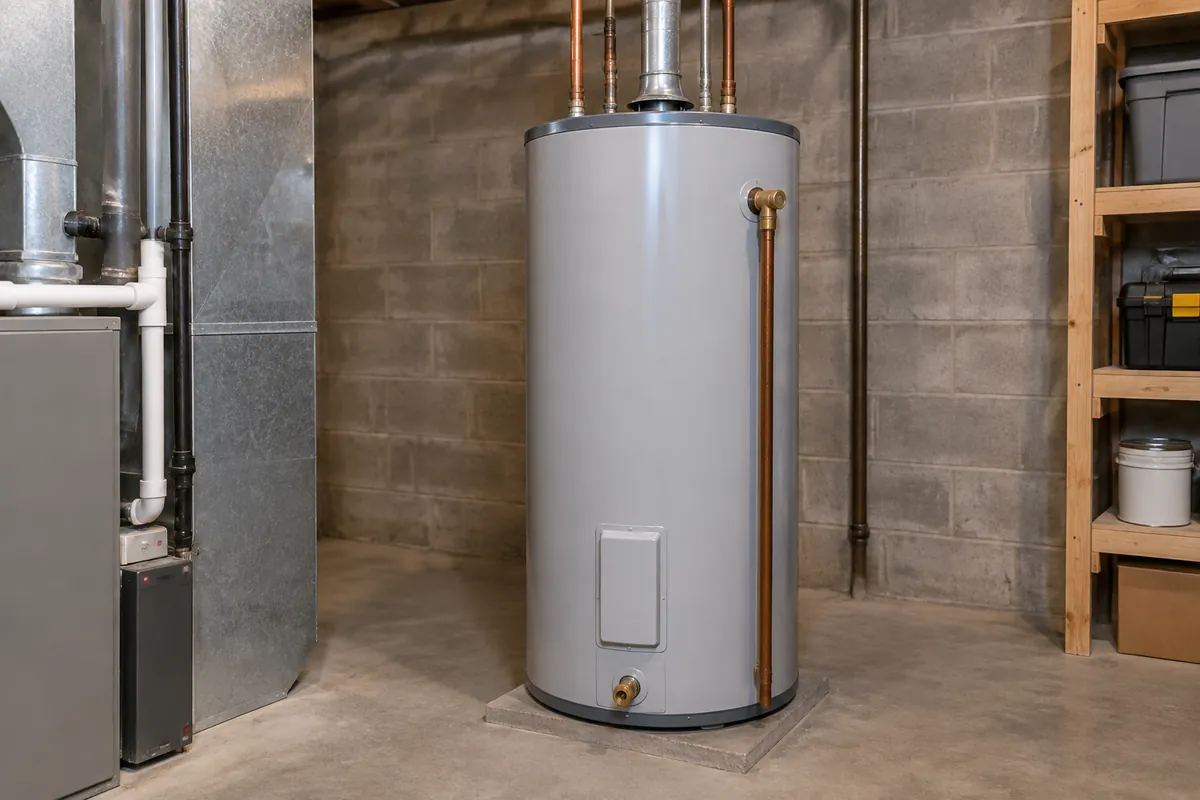
Signs that replacement beats repair
Heaters often give warning before they fail. Some problems are cheap parts, and some mean the tank is finished. Knowing which you have keeps you from putting money into a tank that will not last.
- Water pooling at the base of the tank, not at the pipes on top. A leaking tank cannot be sealed.
- Rust-colored hot water, which can mean the tank lining is breaking down.
- Rumbling or popping from sediment cooking at the bottom.
- A unit older than about ten years that now needs repair after repair.
- Not enough hot water for a household that has not changed.
A leak from the pressure relief valve or a fitting on top is often repairable. Which one you have is worth confirming before choosing a replacement. See water heater repair for the parts that can be fixed.
What a replacement decision involves
| Decision | What to consider |
|---|---|
| Fuel | Gas heaters recover faster. Electric heaters are simpler to install and need no vent. |
| Capacity | Match the tank to the number of people and bathrooms. A forty or fifty gallon tank suits many households. |
| Venting | Gas units need a safe vent path. Older chimneys may need a liner when the new unit is more efficient. |
| Location | Basement units need a drain or pan. Tight closets may limit tank choices. |
| Alternative | A tankless unit costs more up front but takes less space. |
The plumber explains these choices on the call. Mention the age of the current unit, its fuel and where it sits, and the estimate will be much closer to the final price.
What happens on the day
Shut off and drain
Gas or power is turned off and the tank is drained to a floor drain or outside.
Remove the old tank
Connections are cut or unthreaded, and the old unit is carried out.
Set and connect
The new tank is positioned, with new supply connectors, a relief valve and a discharge pipe where required.
Light and test
Gas piping is leak tested, the vent is checked, and the unit is brought to temperature.
Most tank swaps take a few hours. A job can run longer if the vent needs work, the piping is corroded or the old shutoff valves no longer close.
Pennsylvania cost context
HomeServe's Pennsylvania cost guide, dated September 2025, puts the average replacement near $1,411 and the average repair near $374, with a typical lifespan around ten years. Those are published averages, not quotes. The actual price depends on the tank, the fuel, venting and access.
The same guide suggests replacing a heater once repairs start to add up against the cost of a new unit. A plumber can give you a firm number once they know what you have.
Questions that sharpen an estimate
- How old is the tank, and what does the label say for capacity and fuel?
- Is there a drain or pan under it, and where does the relief valve pipe end?
- Does the vent go into a chimney, or straight through a wall?
- Are the shutoff valves above it old and stiff?
- Is the gas or electric supply in good shape, or is it corroded?
A plumber who knows these answers can give a tighter estimate. Photos of the tank label, the vent and the nearby piping make that even easier. If the tank sits above a finished room, say so, because a pan and a drain line become part of the job.