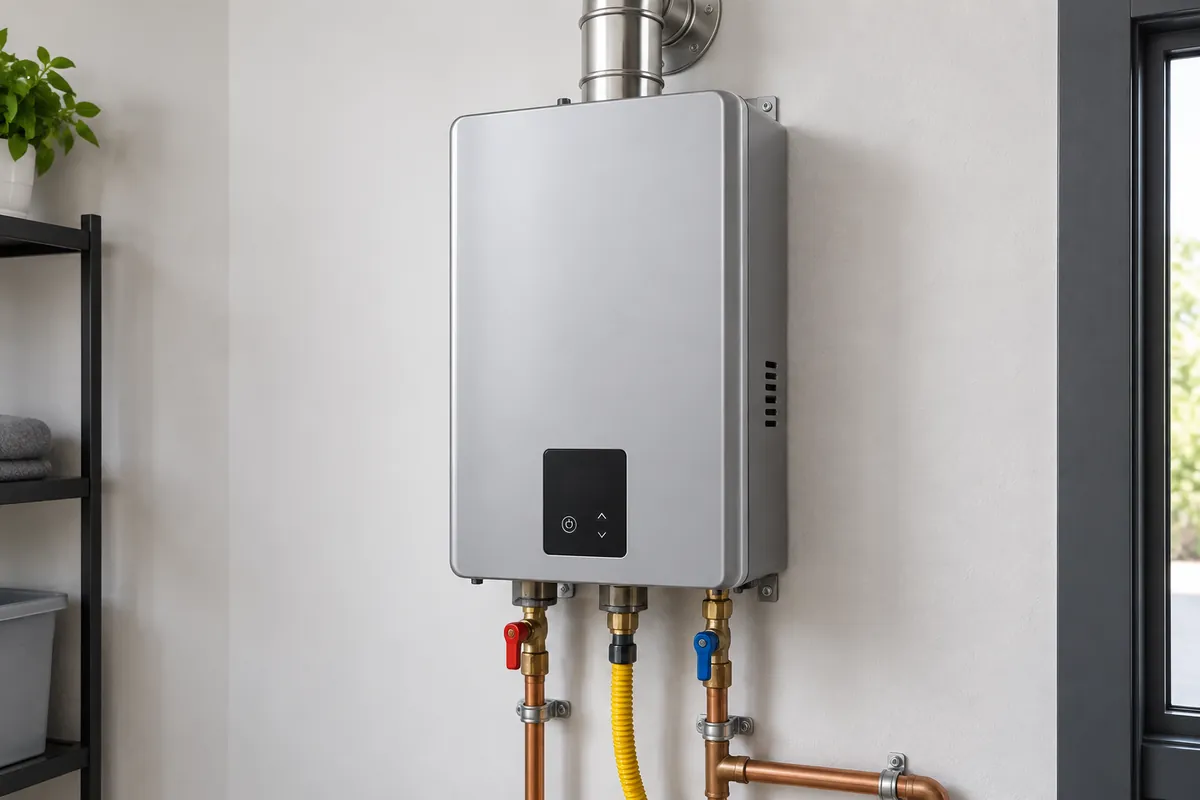
Tank or tankless: the real trade-offs
| Tank heater | Tankless heater | |
|---|---|---|
| Up-front cost | Lower | Higher, often by a wide margin once venting and gas work are included |
| Hot water supply | Limited by tank size, then runs out | Continuous, but limited by flow rate |
| Space | Uses floor space | Wall mounted, frees the floor |
| Installation | Often a straight swap | May need a larger gas line, a new vent and a new electrical outlet |
| Maintenance | Anode and flushing | Periodic descaling, especially with hard water |
A tankless unit does not save money in every house. It makes the most sense where space is tight, a tank is due for replacement and the gas and venting work is straightforward.
Why the gas line is the usual surprise
A gas tankless unit burns far more gas at once than a tank heater, even though it burns for less time. Many older houses have a gas pipe sized for a tank, and it may need to be replaced with a larger one.
Venting is the other common cost. Tankless units need a specific vent material and path to the outside. Reusing an old masonry chimney is usually not an option. See gas line repair for how the piping side works.
Sizing without guessing
Tankless units are sized by flow rate in gallons per minute and by temperature rise. A shower uses around two gallons a minute, and a kitchen faucet or a dishwasher adds to that. If the unit cannot keep up with fixtures running together, the water turns lukewarm.
Cold winters make this matter more. Colder incoming water means a bigger temperature rise, and a unit that works in July may fall short in January.
Hard water and maintenance
Mineral scale builds up inside the heat exchanger of a tankless unit and reduces its output. Most manufacturers recommend periodic descaling, and units in hard water areas need it more often. A water softener can reduce the problem, though whether you need one depends on your water.
Skipping maintenance is a common reason tankless units fail early.
Is your house a good fit
| Good fit | Poor fit |
|---|---|
| A tank is near the end of its life anyway | A newly installed tank with years left |
| Gas line can be upsized without opening finished walls | Gas pipe runs through finished space that would need opening |
| Vent can run straight outside | No practical vent path |
| A small household or space-limited closet | Many fixtures often running at once on a modest unit |
Some people choose a tankless unit for space alone. Others find that the gas, venting and electrical work is more than they expected. Describe your setup on the call, and a plumber can tell you honestly which side of the table you are on.